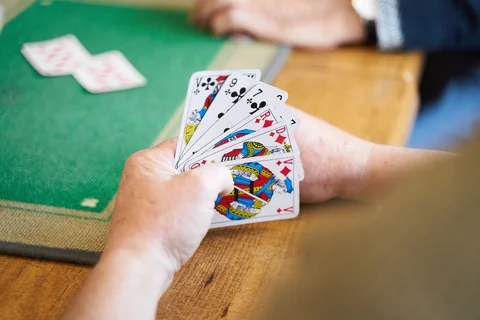
Photo: Wijs (Wise) · Source & licence

A declaration asks the game to accept your entire arrangement. One correct sequence does not prove that every other group is correct. The examples below use common 13-card Indian Rummy requirements; read your table rules for special combinations, controls, and penalties.

Separating these checks is useful because a hand can pass one and fail another. Counting four groups, for instance, says nothing about whether two of them are sequences. Count the kinds of groups as well as their cards.
Assume aces are wild for this round; none appears in this hand. The printed joker below represents 10 of spades:
| Group | Explanation |
|---|---|
| Pure sequence, 3 cards | |
| Impure sequence, 3 cards | |
| Natural set, 3 cards | |
| Pure sequence, 4 cards |
The total is 13. There are three sequences, including two pure sequences, and the king set uses distinct suits. No card is counted twice. The joker has one clear job in one group. This example contains more than the minimum number of sequences, which is permitted under the stated rules.
Assume no card is wild in the groups below. This arrangement contains a four-card pure run and three natural sets:
Every card belongs to an individually valid group, and 4 + 3 + 3 + 3 equals 13. However, there is only one sequence. The sets cannot stand in for the required second sequence.
To repair this hand during play, you would need to change its actual grouping possibilities through future draws and discards. Renaming a set “second life” or changing its position on screen does not turn it into a run.
For this example, ordinary cards are not wild and both printed jokers are substitutes:
The first joker fills 5 of hearts; the second fills 9 of spades. There are 13 cards and two sequences, but neither sequence is pure. The two natural sets do not solve that missing requirement.
This example is why “all groups are valid” and “the hand is valid” are different conclusions. Check the relationship between the groups after checking each group individually.
A finishing turn typically involves drawing, choosing the discard, and presenting the remaining hand. An app may use a finish area, a declaration button, a grouping confirmation, or a different sequence of controls. Learn that flow in its tutorial before relying on it.
If the interface labels a group, still understand why the label applies. Check an unexpected result against the wild-card indicator, selected cards, and table rules. Do not repeatedly submit the same uncertain hand.
When practising, record the precise reason for a failed check: missing pure run, missing second run, invalid set, or leftover card. Then revisit the relevant sets and sequences example. A specific correction teaches more than a generic instruction to play faster.
Not under the common rules used here. All 13 cards may be arranged into permitted sequences if the sequence and purity requirements are met.
That depends on the table and format. Check its published rules; a penalty used by one app should not be assumed for another.
Examples and explanations are written for this guide. Check the linked rules and your chosen game’s own instructions for variations.
Photo: Wijs (Wise) · Source & licence
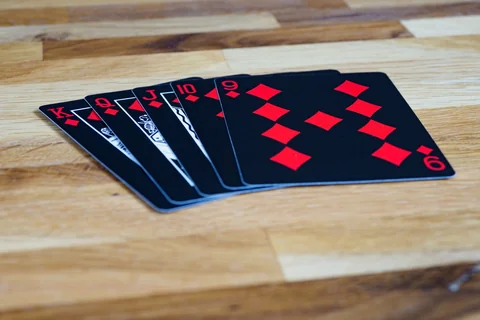
Photo: Brett Jordan · Source & licence
Have a correction? Prepare a feedback note. How we handle sources.