.jpg)
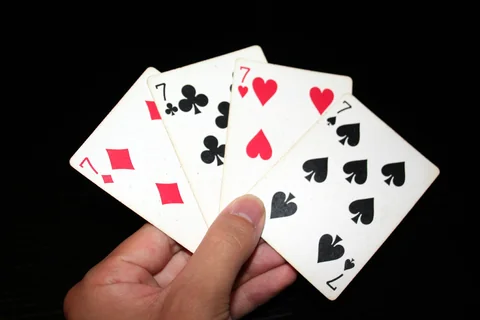
Photo: Enoch Lau · Source & licence

In common 13-card Indian Rummy, a valid declaration needs at least two sequences and at least one pure sequence. The important distinction is whether a card is substituting for something missing. This lesson examines that distinction one group at a time.
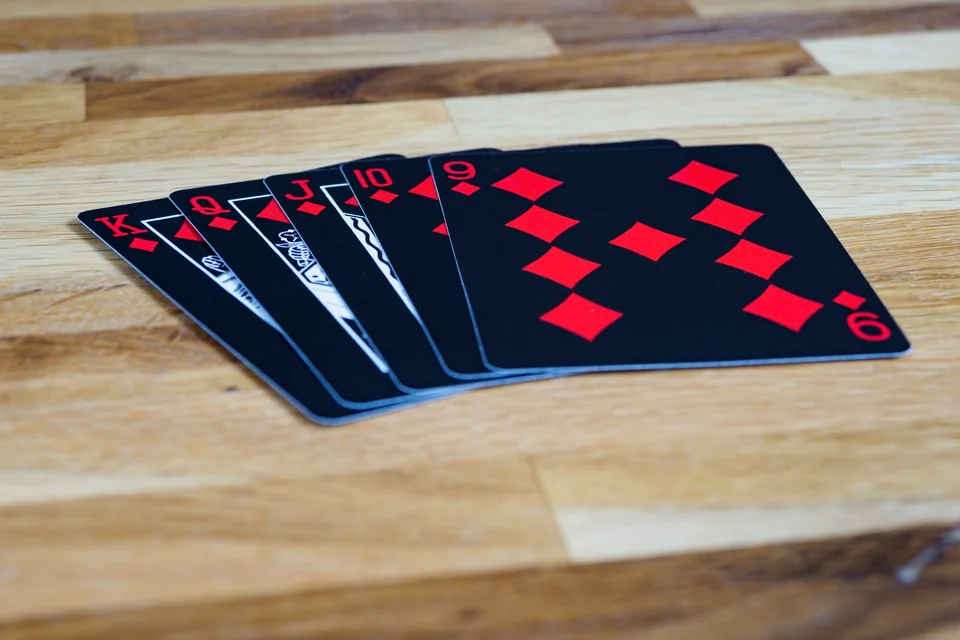
Consider these diamonds:
Every rank follows the previous rank and all three cards belong to diamonds. Nothing is standing in for another card. This is a pure sequence. Adding 6 of diamonds extends the same natural run; it does not change the classification.
Use three checks: at least three cards, consecutive ranks, and one suit with no substituted card. A neat visual row is helpful, but each condition must still hold. For example, 3-4-6 of diamonds fails because the rank 5 is missing.
Here the printed joker represents 9 of clubs:
Read the intended run as 8-9-10 of clubs. The joker fixes a specific missing position, so this is an impure sequence. It can be a valid sequence without being pure.
The joker need not sit in the middle. With a printed joker, 9 of clubs, and 10 of clubs, you could represent 8-9-10. What matters is a legal consecutive run, not the screen position of the substitute. State the intended card explicitly when practising.
Suppose sevens are wild for the round. Under the natural-use convention documented by the references below, this group remains pure:
The 7 of hearts occupies its own printed position between 6 and 8 of hearts. Now change the group:
The 7 of diamonds must substitute for 7 of hearts, making this run impure. The fact that both ordinary cards show a seven does not erase their different suits.
Assume fours are wild and the table allows natural use of wild-rank cards. Classify each group before reading the answer.
Notice that the third group cannot be repaired simply by calling the 6 a joker. Only cards made wild by the actual rules can substitute. Changing the selected wild rank changes the exercise, so always state that assumption first.
When reviewing a full hand, mark one confirmed pure sequence first. Then identify a separate second sequence. That second run may be pure too: you are not required to include an impure run.
Two joker-assisted runs do not satisfy the requirement for a pure sequence, even if both are individually valid. Likewise, one pure run plus several sets still lacks the second sequence. These are whole-hand problems, not problems with the individual groups.
Practise both checks with the complete declaration examples. Keep your named substitutions visible while learning, and recheck them whenever you move a joker to a different group.
No. An impure sequence can be valid. It simply uses a permitted substitute and therefore cannot fulfil the pure-sequence requirement.
No. A printed joker has no natural rank and suit in the run; using it to fill a position makes the sequence impure.
Examples and explanations are written for this guide. Check the linked rules and your chosen game’s own instructions for variations.
Photo: Enoch Lau · Source & licence
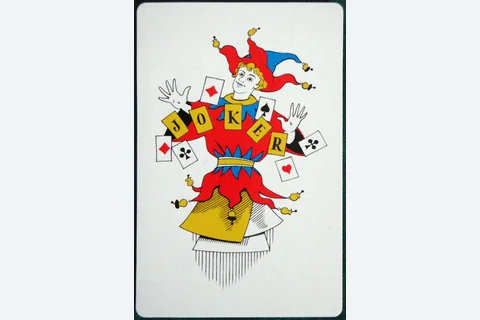
Photo: Teuxe; cropped and perspective-corrected by Hohum · Source & licence
Have a correction? Prepare a feedback note. How we handle sources.